
Choosing between analog and digital note-taking depends on your style and needs. If you prefer tactile engagement, creativity, and eco-friendliness, pen and paper help with memory and focus. If you value organization, quick access, and digital integration, then a tech-based approach suits you. Consider your routine, environment, and learning habits. For a deeper understanding of which method fits best, explore more insights tailored to your lifestyle.
Key Takeaways
- Choose pen and paper for improved handwriting, sensory engagement, and deeper processing, especially if you prefer a tactile learning experience.
- Opt for digital notes if you need quick organization, easy editing, and seamless access across multiple devices.
- Consider analog methods for eco-friendliness, durability, and fostering creativity without reliance on technology.
- Select digital tools for customization, multimedia integration, and to enhance productivity through searchability and quick revisions.
- Match your lifestyle and learning style—use paper for simplicity and authenticity, digital for flexibility and modern convenience.

Plaud Note Pro AI Voice Recorder, Transcribe & Summarize with AI, App Control, Note Taker for Meetings & Calls, Supports 112 Languages, Ultra-Slim w/InstantView Display, Case Included, Black
AI-POWERED TRANSCRIPTION & MULTI-DIMENSIONAL SUMMARIES: Plaud Note Pro is your professional voice transcriber, delivering high-accuracy transcription in 112…
As an affiliate, we earn on qualifying purchases.
As an affiliate, we earn on qualifying purchases.
The Benefits of Pen and Paper

Many people find that writing with pen and paper consistently offers unique benefits. One of these is improving handwriting fluency, as regular practice helps you develop smoother, more natural letter formation. The tactile engagement involved in holding a pen and feeling the paper beneath your hand creates a sensory connection that digital devices can’t replicate. This physical interaction can help you stay focused and engaged, making it easier to remember what you write. Plus, the act of handwriting slows you down just enough to process ideas more deeply, fostering better comprehension. When you write by hand, you’re not just recording information—you’re actively involved in the learning process, which can enhance your overall understanding and retention. Additionally, choosing a dog name that suits your pet’s personality can make the bonding experience even more rewarding. Incorporating consistent handwriting practice can also improve your visual memory, which is beneficial for learning and recall. Engaging in handwritten note-taking can also stimulate spiritual energy by creating a mindful and intentional connection with your thoughts. Moreover, the physical act of writing can activate brain regions involved in memory, further supporting cognitive functions.

Classic Lined Journal Notebook 8.5×11" A4 Hardcover Leather – Brown – 200 Pages College Ruled Large with Sticky Tabs, Pockets, and Pen Loop for Writing and Journaling – Big Hardback Men and Women
DURABLE AND PREMIUM LEATHER-FEEL HARDCOVER FOR EVERYDAY USE – Elevate your writing experience with our 8.5×11” hardcover notebook…
As an affiliate, we earn on qualifying purchases.
As an affiliate, we earn on qualifying purchases.
Advantages of Digital Note-Taking

Digital note-taking makes it easier for you to find and organize information quickly with search functions and folders. You can edit and update your notes anytime without hassle, keeping everything current. Plus, synchronization across devices guarantees your notes are always accessible, no matter where you are. Incorporating effective organization methods such as categorization techniques can further enhance your note management and retrieval efficiency. Additionally, integrating mindfulness practices like focused attention during note review can improve retention and clarity. Being aware of aura variations during study sessions may also provide insights into your emotional and mental states, boosting your overall learning experience and cognitive engagement.
Searchability and Organization
Have you ever struggled to find a specific note amid a sea of paper or scattered files? Digital note-taking makes organization effortless. With features like digital tagging and keyword indexing, you can quickly locate any note without flipping through pages. Additionally, digital literacy plays a crucial role in maximizing these tools’ effectiveness. Here are three key benefits: 1. Searchability: Instantly find notes by typing keywords or tags. 2. Digital tagging: Categorize notes for easy retrieval later. 3. Organized folders: Keep related notes grouped for streamlined access. These tools help you stay organized and save time. Instead of manually sorting through piles, you can focus on your work while digital systems handle the organization for you. The ability to search and categorize enhances productivity and keeps your notes neatly arranged. Additionally, note organization techniques can further improve your ability to manage large collections of information efficiently. Leveraging note-taking apps can also boost your overall organization and efficiency. Incorporating structured note formats can make your notes even more accessible and easier to review later. Using cloud storage can also ensure your notes are safely backed up and accessible across multiple devices.
Easy Editing and Updating
One major advantage of digital note-taking is how easily you can edit and update your notes. Unlike handwritten annotations, digital tools let you quickly revise, add, or delete information without starting over. You can insert new points, correct mistakes, or reorganize content with just a few clicks. This flexibility guarantees your notes stay current and accurate. Digital annotation features make it simple to emphasize key ideas or highlight important details without cluttering your original notes. Plus, you won’t need to worry about messy cross-outs or unclear handwriting. The ability to effortlessly refine your notes saves time and keeps your study materials neat. Additionally, understanding news updates and recent revelations can help you keep your notes comprehensive and up-to-date. Incorporating digital organization techniques can further enhance your note management. Using note version control can help you track changes over time and avoid confusion. Employing privacy considerations ensures your notes remain secure and personal, especially when using cloud storage. Moreover, utilizing essential oil benefits can help improve focus and concentration during study sessions. Overall, digital note-taking streamlines the process of keeping your notes fresh, relevant, and easy to update whenever necessary.
Synchronization Across Devices
With the ability to easily edit and update your notes, staying organized becomes even more seamless when your notes are synchronized across multiple devices. Cloud synchronization guarantees your notes are always current, no matter which device you’re using. This feature allows you to access your notes effortlessly, whether on a smartphone, tablet, or computer, thanks to device compatibility. It eliminates the hassle of manual transfers or backups, saving you time and reducing errors. The convenience of real-time updates keeps your work consistent across platforms.
- Instant updates keep all devices current
- Seamless access enhances productivity
- Compatibility across various devices simplifies note management

The Pencil Grip Original Pencil Grippers 6 Pcs, Improves Kids Handwriting, Ergonomic Pen Holder for Righties & Lefties, Ideal for Kids, Toddlers, Adults, Writing Tool with Finger Cushion
Doctor-Designed for All Ages: Created by a doctor, these pencil grips for adults and kids are widely used…
As an affiliate, we earn on qualifying purchases.
As an affiliate, we earn on qualifying purchases.
Impact on Memory and Retention
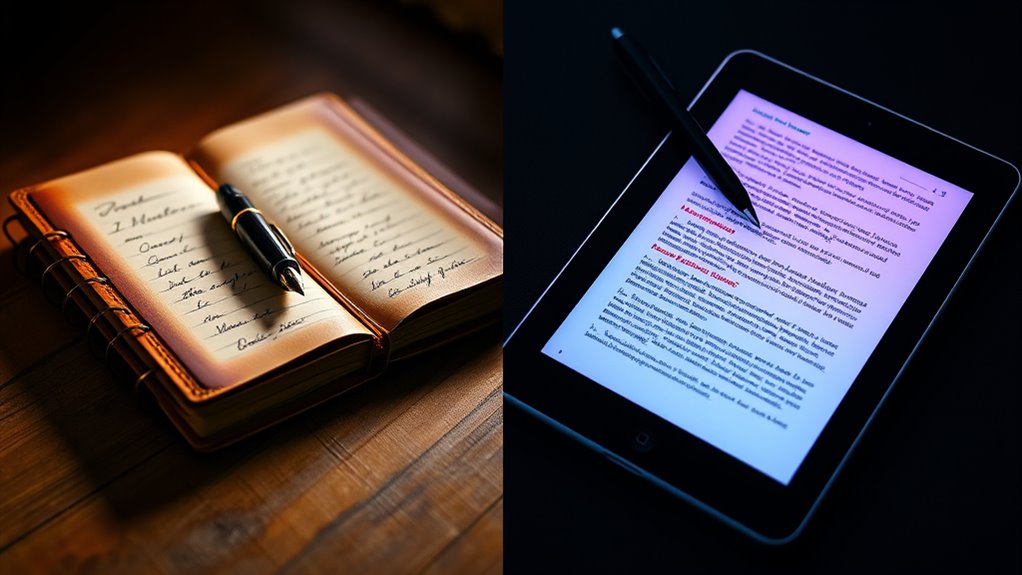
Since note-taking engages active processing, it considerably boosts your memory and retention of information. When you write by hand, you develop muscle memory, which helps reinforce your understanding over time. This physical activity makes it easier to recall details later because your brain associates the act of writing with learning. Digital notes, on the other hand, can be quickly edited or searched, but they may lack the same level of cognitive reinforcement. Handwriting forces you to summarize and synthesize information, deepening your grasp. The kinesthetic experience involved in writing helps cement concepts in your memory. Incorporating sound healing science techniques or engaging with rhythmic patterns can further reinforce memory through auditory stimulation. Recognizing the existential themes behind learning methods can also inspire more mindful and effective study habits. Additionally, exploring multisensory learning approaches can create more immersive and lasting memory connections. Utilizing regional legal resources or understanding local legal processes can also enhance your ability to retain crucial information when navigating complex situations. Being aware of the dream symbols associated with memory and learning can provide unique insights into how your subconscious perceives your educational processes.

iQ Notes Organizer Tablet – Spiral Bound – 80 Sheets – 6 x 8.5 Inches, Multi
Notes organizer
As an affiliate, we earn on qualifying purchases.
As an affiliate, we earn on qualifying purchases.
Flexibility and Customization Options

Flexibility and customization are key advantages of modern note-taking methods, allowing you to adapt your approach to suit your learning style and specific needs. With handwritten aesthetics, you can create unique, artistic notes that reflect your personality and enhance memory. Digital personalization offers extensive options to customize fonts, colors, and layouts, making your notes more engaging and easier to navigate. These features enable you to tailor your notes for maximum effectiveness. Incorporating note organization techniques can further improve your ability to locate and review important information efficiently.
Portability and Accessibility

Modern note-taking methods prioritize not only how you customize your notes but also how easily you can access them anytime and anywhere. Digital options excel in portability, allowing you to carry thousands of notes on a single device, accessible with internet connectivity or offline. They also offer enhanced digital security, protecting your information with encryption and backups. However, digital devices can be fragile, so physical durability varies—screens may crack, and batteries can die. On the other hand, analog methods like notebooks are naturally durable and don’t rely on power, making them simple to carry and access without worry. Yet, they lack instant sharing and backup options. Your choice depends on balancing convenience, digital security, and the physical resilience you need.
Encouraging Creativity and Spontaneity

When you encourage creativity and spontaneity in your note-taking, you boost your imagination instincts and open the door to new ideas. It’s easier to capture spontaneous thoughts and let your mind wander freely. This approach also fosters artistic expression, making your notes more engaging and personally meaningful.
Boosts Imagination Instincts
Note-taking methods can substantially enhance your imagination by encouraging you to think creatively and spontaneously. When you choose a method that fosters visual thinking or free association, you activate your mind expansion and boost creative visualization. This process opens new pathways for ideas to flow naturally, sparking your innate imagination instincts.
Here are three ways your note-taking style can achieve this:
- Using diagrams or sketches to visualize concepts vividly
- Employing free-form notes for spontaneous idea connections
- Incorporating colors and symbols to stimulate creative thinking
2. Encourages Spontaneous Ideas
Encouraging spontaneous ideas requires a note-taking approach that promotes flexibility and free expression. Using mind mapping techniques allows you to capture thoughts as they come, connecting ideas quickly without rigid structure. During brainstorming sessions, your notes can flow freely, enabling you to jot down sudden insights or new concepts without overthinking. Both analog and digital tools support this spontaneity—analog notebooks let you sketch or doodle anywhere, while digital apps offer instant editing and quick access. When you create space for unfiltered thinking, you foster creativity and innovation. Embracing these methods helps your mind stay open, encouraging unexpected connections that can lead to breakthroughs. Ultimately, a flexible note-taking style keeps your ideas flowing and sparks spontaneous creativity whenever inspiration strikes.
3. Fosters Artistic Expression
Fostering artistic expression through note-taking opens up a world of creative possibilities. When you incorporate sketches and doodles, you tap into sketching inspiration that sparks new ideas. Using analog methods, you can easily blend colors and experiment with shading, adding depth and emotion to your notes. Digital tools also support this creativity, with features like color blending and brush options that mimic traditional art.
- Sketch diagrams or abstract shapes to visualize concepts quickly.
- Use color blending to emphasize ideas or create mood.
- Add spontaneous doodles to capture fleeting inspiration.
Both methods encourage spontaneity, but the tactile feel of pen and paper often sparks more spontaneous artistic expression. Your choice depends on how freely you want to explore your creative side.
Organization and Searchability
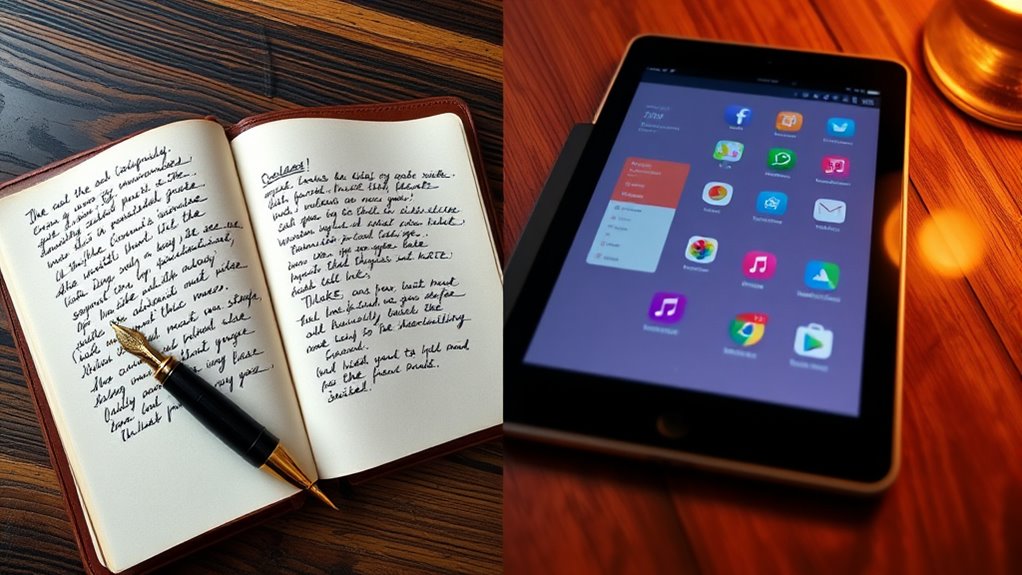
Have you ever struggled to find a specific piece of information in your notes? When you rely on handwriting, organization depends on your method and speed. Handwritten notes can be difficult to search if they’re not well-organized, making it hard to locate details quickly. Digital note-taking, on the other hand, excels in categorization. You can easily tag, label, and sort notes, allowing for instant searchability. Digital tools enable you to create folders or use keywords, making retrieval faster. While handwriting speed can limit how much you jot down quickly, digital methods streamline organization and make searching much more efficient. Ultimately, digital categorization offers a significant advantage when it comes to organizing your notes and finding information swiftly.
Environmental Considerations

Choosing digital note-taking methods not only improves organization but also reduces your environmental impact. Digital tools often use recyclable materials in their manufacturing, lessening waste. Additionally, by switching to digital, you cut down on paper consumption, conserving trees and reducing landfill waste. However, digital devices do require energy consumption, which can impact the environment. To minimize this, you can:
Switching to digital notes reduces paper waste and supports eco-friendly practices.
- Use energy-efficient devices and turn them off when not in use
- Opt for rechargeable batteries to reduce waste
- Support renewable energy sources to power your devices
These choices help lower your carbon footprint and promote sustainability while keeping your notes accessible and organized. Embracing digital methods can be an eco-friendly step toward responsible note-taking.
Choosing the Right Method for Your Lifestyle

Selecting a note-taking method that fits your lifestyle guarantees you stay organized and motivated. Consider your personal routines—if you’re often on the go, digital tools like tablets or smartphones might suit your busy schedule. These devices sync seamlessly across platforms, making it easy to access notes anytime. If you’re less comfortable with technology, analog methods like notebooks or planners can keep you grounded and focused. Your level of technological familiarity influences your choice; opting for what feels natural reduces frustration and increases consistency. Assess how much time you dedicate to note-taking and whether you prefer immediate access or a tactile experience. Ultimately, choosing a method aligned with your daily habits and comfort level helps you stay committed and makes note-taking a productive part of your routine.
Frequently Asked Questions
How Do Note-Taking Methods Influence Learning Styles?
Your note-taking method shapes your learning style by emphasizing penmanship clarity or digital synchronization. If you prefer handwritten notes, you might process information better through tactile engagement, improving retention. Digital tools allow quick editing and easy access, suiting visual or auditory learners. Choosing a method that aligns with your strengths enhances understanding, whether through neat handwriting or seamless digital organization, ultimately boosting your learning effectiveness.
Can Hybrid Approaches Combine the Best of Both Worlds?
They say, “Two heads are better than one,” and a hybrid approach proves just that. By blending techniques, you gain hybrid flexibility, combining the tactile benefits of analog with the efficiency of digital. This allows you to customize your note-taking based on context, boosting retention and organization. Embracing blended techniques helps you adapt to different learning situations, making your study sessions more effective and versatile.
What Are the Cost Differences Between Analog and Digital Tools?
The cost comparison shows that analog tools like notebooks and pens are generally cheaper upfront, fitting within your budget considerations. Digital tools, however, often require an initial investment for devices and subscriptions, which can add up over time. Consider your budget and how much you’re willing to spend, then choose the method that offers the best value for your needs. Digital might save money long-term if you prefer tech features.
How Do Note-Taking Habits Impact Long-Term Knowledge Retention?
Your note-taking habits substantially impact long-term knowledge retention by strengthening memory reinforcement. When you actively engage with material, you reduce cognitive load, making it easier for your brain to process and store information. Consistently reviewing and organizing your notes helps solidify learning, ensuring that knowledge sticks over time. Developing effective habits, whether through analog or digital methods, boosts retention and makes recalling information more effortless in the future.
Are There Specific Methods Suited for Different Professions or Fields?
You’ll find that mindfulness journaling works best for those in counseling, coaching, or creative fields, helping you process emotions and ideas. If you’re in engineering or design, digital note-taking excels for drawing technical schematics and detailed diagrams. Choose your method based on your profession; using analog tools for mindfulness journaling and digital platforms for technical schematics maximizes your efficiency and clarity.
Conclusion
Ultimately, whether you choose pen and paper or digital notes, the right method can transform your learning and productivity. Think of it as finding the perfect key to unseal your genius—nothing less! While pen and paper offer timeless charm, digital tools bring futuristic convenience. Try both, mix them up, and discover what fuels your creativity and keeps you organized. Your ideal note-taking method is out there, waiting to make your ideas explode with brilliance!