TL;DR
A stylish leather wallet balances appearance, construction, and the cards and cash you actually carry. Choose a shape and leather finish that suit your routine, inspect the stitching and edges, and check brand-specific sizing and care guidance before buying.
Your wallet can be the smallest thing in your outfit and still be the one you notice every time you sit down. A bulky bifold presses against your pocket; a slim cardholder slips out smoothly when you pay for coffee. Comfort, useful space, and a finish you enjoy all shape whether a wallet feels right day after day.

Get your wardrobe favorites delivered free with Prime
- Fast, free delivery on millions of items
- Prime Video, Amazon Music and more included
- Member-only deals all year
This guide helps you choose among bifolds, cardholders, leather types, colors, and useful features without mistaking a polished product photo for proof of quality. You’ll learn what to inspect, how to match a wallet to your routine, and how to care for it as the leather softens and changes. The right choice depends on what you carry and what you wear—not a universal rule about how a man should look.
Choose a bifold, cardholder, or travel wallet based on the cards, cash, and documents you use regularly.
Full-grain preserves more natural surface variation; top-grain is typically finished for a more uniform look.
The phrase “genuine leather” alone does not identify a grade, so check the material description.
Inspect stitching, edges, seams, and card slots as well as the leather surface.
Treat RFID blocking as an optional feature for certain signals, and follow care guidance for your wallet’s finish.
Choose a shape that fits your actual daily carry
A stylish leather wallet should hold the cards, cash, and identification you use without making your pocket uncomfortable. A bifold gives you room for several cards and folded bills, while a cardholder keeps your carry smaller and lighter. Your daily routine is a better guide than a photo of an empty wallet.
For instance, if you use four cards, a transit pass, and a few bills, a compact bifold may keep everything in one place. If you pay by phone and carry two cards, a slim cardholder may sit more comfortably in the front pocket. A travel wallet can make sense for boarding passes and documents, but can feel oversized when your main errand is a quick lunch.
Before buying, count what you actually carry on a normal weekday. Include the membership cards and old receipts you tend to forget. A wallet designed for six cards will not stay slim if you force in twelve; the slots can loosen and the seams can take extra strain. Leave room for removal so cards slide out without a tug.
Try the loaded wallet in the pocket where you expect to keep it, if you can. A soft pair of trousers may show a thick outline more than a structured jacket does. Style depends on fit, clothing, and use; it is not a test of whether you have the “right” body or wardrobe.
- List the cards and cash you use most weeks.
- Pick a bifold, cardholder, or travel style based on that list.
- Check the wallet’s loaded dimensions against your usual pocket.
Popular right now

Bose QuietComfort Headphones (2nd Gen) Wireless Noise-Cancelling Headphones, Black

Shark PowerPro Reveal Plus Cordless Stick Vacuum, Charcoal, IZ376H

Vitamix Nano Personal Blender with SmoothiePilot, Black
As an affiliate, we earn on qualifying purchases.
Read leather labels before you pay for the finish
Full-grain leather keeps more of the hide’s natural surface, while top-grain leather is typically sanded or finished for a more uniform look. Neither label tells the whole story: construction and finish matter too. “Genuine leather” is a broad label, not a clear grade or a guarantee of a particular lifespan.
Full-grain leather often shows natural variation and can develop a patina: a gradual change in color and sheen from handling and exposure. If you carry a chestnut wallet in a front pocket every day, its edges may darken and its surface may become softer. That change can feel like character if you enjoy a wallet that records its use. If you prefer a consistent color, a more even top-grain finish may suit you better.
Bonded leather is made from leather fibers and binding materials, so it differs from a solid hide in structure and how it ages. Ask for a specific material description rather than relying on the word “premium.” Suede and pebbled finishes add texture, but they also call for care suited to their surfaces. A conditioner intended for smooth leather may not be right for suede.
When you browse product details, look for the leather type, finish, and care instructions together. A clear listing makes it easier to judge whether that soft, matte brown surface or glossy black finish suits your taste. Material names help you compare; they do not replace a close look at stitching, edges, and slot construction.
Key fact: “Genuine leather” alone does not identify a leather grade. A specific description, such as full-grain or top-grain, tells you more about how the material was selected or finished.
Match the color and texture to clothes you already wear
Black and dark brown wallets are easy to pair with many outfits, while tan, burgundy, navy, and green add color without demanding attention. The best choice is the one that works with your wardrobe and feels like yours. There is no required color match between a wallet, belt, or shoes.
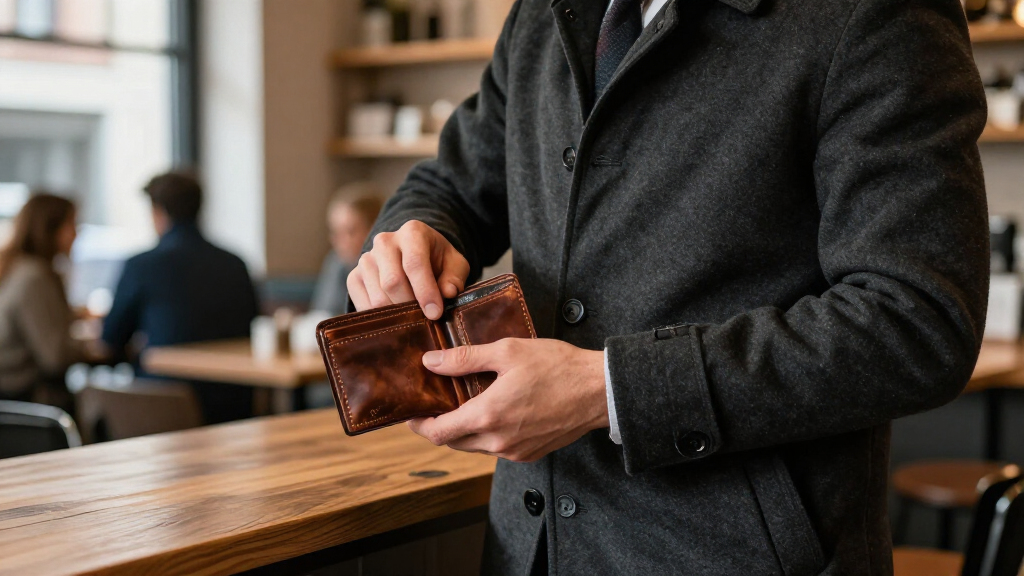
For example, a dark brown bifold can sit comfortably beside a navy suit, denim, or a tan jacket. A burgundy cardholder may add a quiet pop of color when you take it out at a café, even if most of your clothes are gray and blue. Pebbled leather brings a tactile, slightly rugged look; a smooth finish can feel cleaner and more formal.
“What makes a leather wallet stylish” depends on how well its shape, color, texture, and construction suit your clothes and routine. A wallet with neat stitching and restrained branding can look considered without drawing attention. Some people like visible texture or a brighter color; others prefer a plain black surface that disappears into a work bag.
Try placing a wallet beside a pair of shoes or a jacket you wear often, rather than imagining it with an outfit you rarely use. That quick check gives you a more honest sense of whether it will fit into your everyday rotation. Style depends on the person, and sizing varies by brand, so check the product’s listed dimensions before you order.
Check the stitching and edges for signs of careful work
Even stitching, clean edges, secure seams, and snug card slots are practical clues to how a wallet was put together. Inspect the stress points, especially the fold, corners, and slot openings, because those areas bend or see friction each day. An attractive surface alone cannot tell you whether those details will hold up.
Imagine a wallet you pull out several times during a busy commute. If the fold feels stiff and the slot edges look rough, those small flaws may become annoying well before the leather itself looks worn. By contrast, smooth finished edges and tidy, evenly spaced stitches give you a more reassuring first impression. A well-made wallet should also keep cards secure without making them difficult to remove.
When you shop in person, open and close the wallet and put a card in a slot. Look at how the lining meets the leather and whether the corners sit neatly. Online, read close-up product photos and check the material and construction description. If the listing avoids saying what the wallet is made from, ask the seller for more detail where possible.
Do not treat a leather grade as a substitute for these checks. Full-grain leather with rough finishing may not suit you as well as a carefully made wallet in a more uniform top-grain leather. Craftsmanship shows up in the small details: the parts you touch, bend, and use every day.
Decide whether RFID blocking adds value for your cards
RFID-blocking wallets include a layer meant to block certain radio-frequency identification signals from contactless cards. It can appeal if you want that specific layer of signal shielding, but it does not address every form of payment-card risk. Check what the claim covers instead of assuming “RFID protected” means universal security.
For example, if you carry contactless cards and like knowing the wallet has a blocking layer, that feature may be worth comparing alongside size, leather, and price. If your card issuer provides transaction alerts, those alerts and ordinary care with your card details are separate parts of your security habits. A wallet feature does not replace them.
Compare product descriptions carefully. Does the maker say which signals or frequencies the wallet is designed to block? If the listing only uses a broad label without explaining its scope, you have little information to judge the feature. RFID protection is an optional product detail, not a measure of leather quality or construction.
Picture choosing between two otherwise similar bifolds: one has RFID blocking and one does not. If the feature matters to your preferences and the added cost works for you, it can be a reasonable choice. If you mainly need a comfortable wallet with secure slots and neat seams, those everyday details may matter more to you.
Keep leather looking good with simple, finish-specific care
Leather can darken, soften, and pick up marks through regular use; care helps manage that change, but no leather wallet is maintenance-free. Keep it dry when you can, wipe away surface dirt with a soft cloth, and follow the maker’s instructions for the particular finish.
If a wallet gets wet in the rain, gently blot it with a clean cloth and let it air-dry away from direct heat. Setting it on a radiator may seem like a quick fix, but heat can affect leather as it dries. A wallet that gets splashed on the walk home from the station needs a little patience, not a hair dryer.
Conditioner can help some smooth leather, but use it sparingly and only if the maker recommends it. Products meant for smooth leather may not suit suede, and too much conditioner can affect the surface. If you are unsure, start with the care label or ask the maker about that specific finish.
It also helps to avoid overfilling the wallet. Shoving extra cards into tight slots can stretch them and strain the seams, while receipts left inside can add bulk. Carry what you need, let the wallet dry naturally if it gets damp, and treat developing patina as a normal part of use rather than a defect you must scrub away.
Frequently Asked Questions
Which leather is best for a wallet?
It depends on the look and aging you prefer. Full-grain leather keeps more natural surface variation and often develops patina, while top-grain leather is typically finished for a more consistent appearance. Construction matters alongside leather type.
Should I choose a bifold or a cardholder?
Choose a bifold if you carry several cards and folded cash; choose a cardholder if you want a smaller, lighter carry. Count the cards you use in a normal week and consider where you usually keep your wallet.
How many cards should a wallet hold?
Choose enough slots for the cards you actually use, with room for each card to slide out comfortably. Overloading a wallet can stretch its slots and put stress on seams. Removing old receipts and rarely used cards can help it stay slimmer.
Does a leather wallet need conditioning?
Not always. Follow the maker’s care instructions and use a product suited to the wallet’s leather and finish. Too much conditioner can affect the surface, and a product for smooth leather may not suit suede.
Are RFID-blocking wallets necessary?
RFID blocking is an optional layer designed to block certain signals. Check the maker’s explanation of what it covers, since the feature does not address every form of card security risk. It is a personal preference, not a requirement for a stylish wallet.
What color is most versatile?
Black and dark brown are traditional choices that pair easily with many wardrobes. Tan, burgundy, navy, and green can also work well depending on your clothes and taste. Pick a color you will enjoy carrying, rather than following a strict matching rule.
Conclusion
Choose the wallet that holds your usual carry without fighting your pocket, then check its leather description, stitching, and care guidance. Comfort and construction make style useful; the color and finish give it your own character.
Carry what you need, leave room for the leather to age, and let a few years of daily use write its story.