

Simplifying your environment reduces distractions and mental load, helping you think more clearly and sparks creativity. By embracing minimalist design, focusing on essential elements like limited color palettes and clean lines, you can highlight textures and shapes that inspire new ideas. Decluttering and using creative constraints challenge you to explore deeper without overwhelming your senses. Keep exploring how minimalism can unleash your creative potential and guide you toward more authentic and innovative expression.
Key Takeaways
- Simplified environments reduce distractions, allowing deeper focus and fostering innovative ideas.
- Minimalist design highlights essential elements, inspiring new connections and creative insights.
- Embracing constraints like limited color palettes encourages originality and emotional depth.
- Decluttering mental and physical spaces clears the way for clearer thinking and artistic exploration.
- Focusing on core concepts and using intentional simplicity can ignite fresh inspiration and authentic expression.
The Psychology Behind Simplicity and Innovation

Understanding the psychology behind simplicity and innovation reveals that our minds often find clarity more stimulating than clutter. The neuroscience of simplicity shows that when we reduce distractions, our brains experience increased cognitive ease, making it easier to focus and process information. Simplified environments minimize mental load, allowing us to think more clearly and creatively. This mental clarity can be further enhanced by incorporating minimalist design principles, which streamline visual elements and reduce sensory overload. The reduction in mental clutter can also lead to improved problem-solving abilities, as it creates space for new ideas to emerge. Calming environments with minimal distractions help enhance focus and inspire innovative thinking. Neural pathways become more accessible when unnecessary stimuli are eliminated, fostering creative insights. Cognitive ease encourages mental agility, helping us to connect concepts more effortlessly. Embracing minimalism taps into this neurological advantage, making it easier to generate fresh insights and approach problems with a clearer, more inventive mindset. Recognizing the importance of visual clutter and its impact on mental clarity further underscores the value of simplicity in fostering creativity, especially when considering how risk management techniques can help maintain focus amidst market fluctuations. Additionally, understanding the role of emotional alignment can enhance our ability to stay inspired and motivated within minimalist environments, supporting sustained innovation.
How Decluttering Sparks Creative Thinking

When you declutter your space, you create an environment that naturally encourages creative thinking. A tidy area reduces visual distractions, allowing your mind to focus and explore new ideas. Incorporating principles of color theory, you can select calming shades that foster concentration or vibrant hues that spark energy and inspiration. Simplifying your surroundings enhances sensory engagement by highlighting textures and shapes, making it easier to notice details you might overlook in chaos. This clarity helps your brain form new connections and generate innovative solutions. By removing clutter, you establish a mental space that’s open to experimentation and creative exploration, fostering a mindset receptive to novel ideas. Additionally, understanding how nutrient-rich ingredients can support brain function underscores the importance of a clean, minimal environment for optimal mental clarity. Recognizing the influence of psychological tactics such as mindfulness and focus techniques can further enhance your creative process. Ultimately, a minimalist environment acts as a catalyst, *disentangling* your creative potential through intentional simplicity.
Minimalist Design and Artistic Expression

Have you ever noticed how minimalist design emphasizes simplicity to make artistic expression more powerful? It focuses on clean lines and essential elements, allowing your message to stand out. Color palettes are typically restrained, using neutral tones or a few carefully chosen shades to evoke emotion without overwhelming. Material textures also play a pivotal role; smooth surfaces, natural wood, or matte finishes add depth and tactile interest without clutter. By stripping away unnecessary details, minimalist design directs attention to the core of your artwork, encouraging viewers to engage more deeply. This approach fosters clarity and emotional impact, making your artistic expression more profound. When you embrace simplicity in your design, you create a space where ideas can breathe and resonate more effectively. Additionally, understanding support hours can help artists plan their visits or project schedules around available resources. Incorporating creative constraints can further inspire innovative solutions within minimalist frameworks, emphasizing the importance of design discipline in achieving a balanced aesthetic. Moreover, leveraging AI tools for inspiration can help refine and enhance minimalist concepts efficiently. Recognizing the significance of Material textures can also enhance the tactile dimension of minimalist art, adding subtle richness without compromising simplicity.
Practical Steps to Incorporate Minimalism Into Your Creative Process

Incorporating minimalism into your creative process starts with intentional choices that prioritize clarity over clutter. Focus on simplifying your palette and material selection to avoid distraction. Use color theory to select a limited, harmonious color scheme that enhances your message without overwhelming the senses. Streamline your workspace by removing unnecessary tools and objects, creating a space where ideas can breathe. Emphasize quality over quantity in your materials, choosing those that serve your vision best. Practice editing ruthlessly—remove anything that doesn’t add value or clarity. By consciously applying these minimal principles, your creativity becomes more focused, impactful, and authentic. Remember, less often leads to more when it comes to inspiring and effective art. Incorporating design principles can further help you create a balanced and inspiring environment that fuels your creativity. Additionally, adopting comfort solutions such as ergonomic furniture can enhance your workspace, making it more conducive to sustained creative effort. To optimize your environment, consider exploring workspace organization techniques that reduce visual noise and promote focus. Paying attention to visual hierarchy can help ensure your work communicates your message effectively without unnecessary complexity.
Case Studies: Creatives Who Thrive With Less

Ever wondered how some creatives produce powerful work with surprisingly minimal resources? These artists often draw on tech innovation and cultural influences to amplify their ideas without excess. For instance, minimalist designers leverage simple tools and clean lines, showing that less truly can be more. Similarly, musicians sometimes use sparse arrangements inspired by cultural traditions that emphasize storytelling over complexity. These creators focus on core concepts, avoiding distractions, and allowing authenticity to shine through. Their success demonstrates that minimalism isn’t a limitation but a catalyst for clarity and originality. By embracing fewer resources and trusting their instincts, they prove that innovation thrives when you strip away the unnecessary, emphasizing the power of thoughtful simplicity. Incorporating interior design principles like layering textures and selecting functional antiques can further enhance their creative environments, fostering inspiration and focus. Additionally, understanding financial management helps these creators allocate their limited resources effectively to sustain their work. Recognizing the importance of ethical leadership in their practices can also build stronger connections with their audiences and communities.
Balancing Minimalism and Inspiration for Continuous Growth
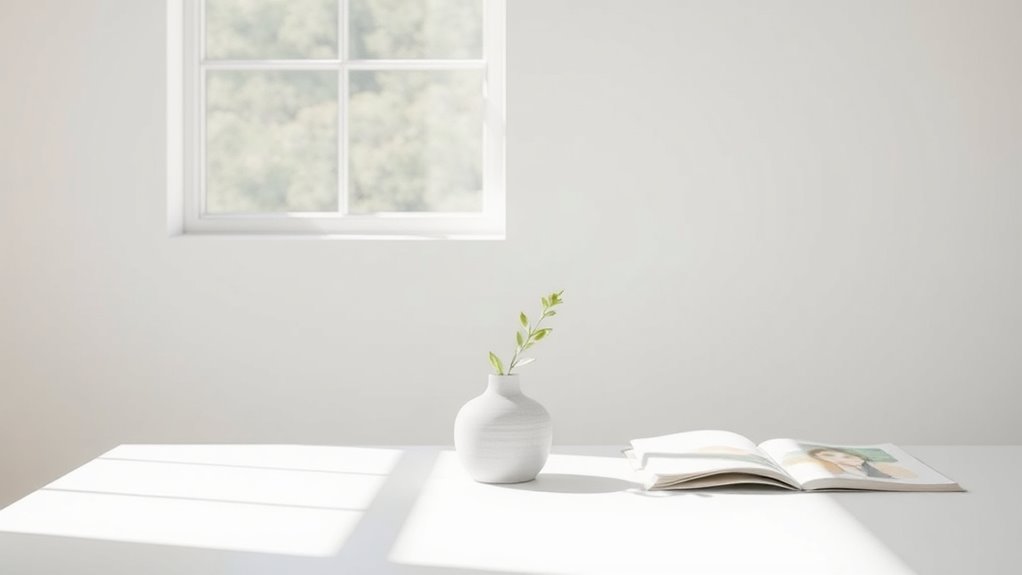
To keep growing creatively, you need to focus on what truly matters and eliminate distractions. Embracing creative constraints can spark innovative ideas, even within minimal resources. Cultivating mindful practices helps you stay inspired while maintaining the balance between simplicity and inspiration. Recognizing the importance of compatibility factors can also guide you in aligning your environment and relationships to foster ongoing creative growth. For instance, selecting tools that are compact and portable can support your minimalist approach and ensure you stay adaptable in various settings. Additionally, understanding how to shift gears smoothly on your bicycle can serve as a metaphor for adjusting your mindset and strategies efficiently in your creative journey.
Prioritize Essential Elements
Balancing minimalism with inspiration requires you to focus on what truly matters, stripping away distractions while leaving room for creativity to flourish. Prioritizing essential elements helps you create impactful work by emphasizing key aspects like color theory and sensory engagement. By narrowing your focus, you allow your audience to connect deeply with your message without overwhelm. Consider these strategies:
- Use color intentionally to evoke emotion and guide attention
- Simplify shapes and forms to enhance clarity and impact
- Limit your palette to avoid visual clutter
- Focus on sensory cues that deepen engagement and inspire curiosity
This approach ensures your work remains meaningful and inspiring, fostering continuous growth without sacrificing the power of simplicity. When you elevate only what’s essential, your creativity becomes more intentional and vibrant.
Embrace Creative Constraints
By focusing on what truly matters, you create space for innovative solutions within minimalism’s boundaries. Embracing creative constraints, such as limiting your color palette based on color theory, can heighten emotional resonance. When you restrict choices, you force yourself to explore deeper nuances, making each element more meaningful. For example, using only a few carefully selected colors can evoke strong feelings and direct attention where it’s most impactful. These boundaries challenge you to think more creatively, sparking fresh ideas within simplicity’s framework. Constraints aren’t roadblocks—they’re catalysts for originality. When you leverage them intentionally, you foster continuous growth, blending minimalism with inventive expression. This approach transforms limitations into opportunities for deepening emotional connection and inspiring authentic creativity. Additionally, applying thoughtful design elements like lighting fixtures and textures can enhance the overall aesthetic within minimal constraints, creating a harmonious and inspiring space.
Cultivate Mindful Practices
Practicing mindfulness helps you stay rooted in the present, allowing you to appreciate the simplicity of minimalism while remaining open to new inspiration. By engaging in mindful meditation, you cultivate awareness of your thoughts and surroundings, fostering intentional living. This balance keeps your creative energy flowing without distraction or overwhelm. To deepen this practice, consider:
- Setting aside daily moments for mindful meditation
- Simplifying your environment to reduce mental clutter
- Reflecting on your goals with deliberate focus
- Incorporating mindful pauses during creative tasks
These habits reinforce your connection to the present, encouraging continuous growth through clarity and purpose. Embracing mindful practices helps you sustain inspiration while honoring the minimalist principles that fuel your creativity.
Frequently Asked Questions
Can Minimalism Hinder Creativity in Complex Projects?
Minimalism doesn’t have to hinder your creativity in complex projects; instead, it can enhance your conceptual depth. By stripping away excess, you gain clearer focus and can explore ideas more deeply. This approach actually boosts your creative freedom, allowing you to experiment within a simplified framework. Embracing minimalism helps you prioritize key elements, fostering innovative solutions without feeling overwhelmed by unnecessary details.
How Do Cultural Differences Influence Minimalist Approaches to Art?
Cultural differences shape minimalist art like a palette influences a painting’s tone. You’ll find that cultural expressions deeply influence how minimalism is approached, highlighting aesthetic diversity across regions. In some cultures, simplicity embodies spiritual purity, while others see it as a way to emphasize form and function. Embracing these differences enriches your understanding of minimalism, showing that simplicity isn’t one-size-fits-all but a reflection of diverse cultural values.
Is Minimalism Suitable for All Creative Disciplines?
Minimalism suits many creative disciplines because it emphasizes clarity and purpose through minimalist design and creative simplicity. You’ll find it effective in fields like graphic design, architecture, and even writing, where stripping down to essentials sparks innovation. However, it may not fit all areas, especially those valuing intricate detail or emotional complexity. Ultimately, you should assess whether minimalist principles enhance or hinder your specific creative goals.
What Role Does Emotional Connection Play in Minimalist Art?
Emotional connection plays a vital role in minimalist art by creating emotional resonance that deeply engages you as a viewer. When artists strip away excess, they invite you to focus on essential elements, making your experience more personal and meaningful. This simplicity enhances viewer engagement, allowing you to connect with the artwork on a deeper level, evoking feelings that might be lost in more complex, cluttered compositions.
How Do Minimalist Environments Impact Long-Term Motivation?
Minimalist environments boost your long-term motivation by encouraging mindful focus, allowing you to concentrate on what truly matters. With fewer distractions, you find it easier to stay engaged and maintain sustained inspiration over time. This simplicity helps you develop better habits, fosters clarity, and keeps your goals clear, ultimately empowering you to persist and grow creatively without feeling overwhelmed.
Conclusion
Embracing minimalism is like clearing away the fog to reveal your true creative landscape. When you simplify your surroundings and focus on what truly matters, inspiration flows effortlessly, like a river finding its path. By balancing less with more, you open the door to endless possibilities. So, take a step back, declutter your mind, and let the beauty of simplicity guide your creative journey—because sometimes, less truly is more.