Choosing the best cooling fan for a desk area involves balancing quiet operation, airflow, size, and features. The Personal Tower Cooling Fan stands out for its quiet and adjustable airflow, making it ideal for focused work. The Honeywell TurboForce Air Circulator models excel in versatile pivoting and multiple speed settings for adaptable cooling. The main tradeoffs include noise levels versus airflow power and size versus portability. Continue reading to see how each option compares and which is best suited for your desk setup.

Get your wardrobe favorites delivered free with Prime
- Fast, free delivery on millions of items
- Prime Video, Amazon Music and more included
- Member-only deals all year
Key Takeaways
- The most effective fans offer a balance of quiet operation and adjustable airflow for personalized comfort.
- Size and noise levels often trade off with airflow power, requiring buyers to prioritize their workspace needs.
- Pivoting and oscillation features significantly enhance cooling coverage in small desk areas.
- Portable, rechargeable fans provide flexibility but may sacrifice some airflow capacity compared to larger models.
- Higher-priced options tend to deliver quieter operation and more refined features, justifying the investment for sensitive environments.



| cooling fans for desk area | Noise Level | Size |
|---|---|---|
| Personal Tower Cooling Fan wit | 25-45dB | 13 inches |
| Honeywell TurboForce Air Circu | 25% quieter than comparable fans | Small |
| Honeywell TurboForce Air Circu | 25% quieter | Small |
| Honeywell QuietSet Personal Ta | — | 13 inches |
| Levoit Tower Fan for Bedroom | 20-43dB | — |
| USB Desk Fan with 100 Speeds | 28dB | — |
| Amazon Basics Air Circulator D | — | — |
More Details on Our Top Picks
Personal Tower Cooling Fan with Quiet Operation and Adjustable Airflow
This tower fan stands out for its combination of powerful airflow—up to 24ft/s—and quiet operation, making it suitable for both sleep and work environments. Its dual oscillation angles and three speed settings allow for customized cooling, surpassing many small desk fans that lack adjustable airflow. Compared with the Levoit Tower Fan, this model offers a slightly larger size but adds energy-saving features and a built-in timer. The main tradeoff is its limited capacity for larger rooms, as its compact size is designed for personal spaces. The portability with a built-in handle makes it easy to move around a desk or room, but it may not suffice where high airflow over larger areas is needed.
Pros:- Powerful airflow up to 24ft/s with adjustable settings
- Ultra-quiet operation at 25-45dB ideal for sleep or concentration
- Compact, portable with a built-in handle for easy movement
- Energy-efficient with a programmable 12-hour timer
Cons:- Limited airflow capacity for large or open spaces
- No remote control included which limits convenience
Best for: Individuals needing a quiet, versatile fan for bedrooms or offices with limited space
Not ideal for: Users looking to cool larger rooms or needing remote control functionality
- Airflow Speed:up to 24ft/s
- Oscillation Angles:60° and 110°
- Noise Level:25-45dB
- Timer:12 hours
- Size:13 inches
- Power Consumption:Energy-efficient
Our verdict“This fan is perfect for those who want customizable, quiet cooling in a small, portable package.”
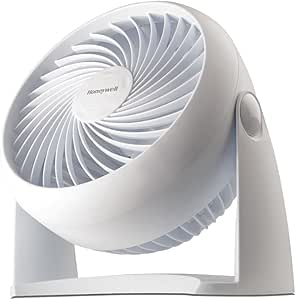
Honeywell TurboForce Air Circulator Small Tabletop Fan, 3 Speeds, 90° Pivot, White
This Honeywell model is a strong choice for those on a budget who need effective airflow in small to medium rooms. Its aerodynamic turbo design provides more powerful circulation than typical small fans, with three speeds and a 90-degree pivot head for directional control. Compared to the black version (B001R1RXUG), this white model offers similar functionality but may appeal visually to different decor styles. Its limited size and three-speed operation make it less suitable for larger spaces or high airflow needs, but it excels in quiet, energy-efficient performance for personal or desk use. Its simple design keeps it easy to operate, though it lacks remote control or advanced features.
Pros:- Quiet operation, 25% quieter than comparable fans
- Adjustable speeds and pivoting head for personalized airflow
- Compact, lightweight, and easy to place on desks or nightstands
Cons:- Limited to small or medium-sized rooms
- No remote control or smart features for remote operation
Best for: Office workers or students needing a compact, quiet fan for small desks or personal space
Not ideal for: Those wanting a fan capable of cooling larger rooms or with multiple advanced features
- Size:Small
- Type:Tabletop Fan
- Speeds:3
- Pivoting Head:Yes, 90°
- Noise Level:25% quieter than comparable fans
- Color:White
Our verdict“Ideal for budget-conscious users seeking reliable, quiet airflow in small areas.”
Honeywell TurboForce Air Circulator Small Tabletop Fan, Quiet Personal Fan for Home or Office, 3 Speeds, 90° Pivoting Head, Black
This black Honeywell fan is tailored for personal use—its compact size and quiet operation make it ideal for desks or small spaces. Similar to its white counterpart, it offers three adjustable speeds and a 90-degree pivoting head for directional airflow. Compared to larger stand fans, this model emphasizes portability and discreet operation, perfect for focused cooling. While it provides enough airflow for individual comfort, it’s not suited for cooling larger areas or multiple users. Its black finish blends well with modern decor, but it doesn’t include remote features, so adjustments need to be manual.
Pros:- Quiet operation with 25% less noise than similar fans
- Adjustable 90° pivoting head for directed airflow
- Small size fits easily on desks or shelves
Cons:- Limited to personal or small space cooling
- Lacks remote control or app connectivity
Best for: Individuals who want a small, quiet fan that fits neatly on a desk or nightstand
Not ideal for: Those needing a fan with remote control or for larger, shared spaces
- Size:Small
- Type:Tabletop Fan
- Speeds:3
- Pivoting Head:90 degrees
- Noise Level:25% quieter
- Color:Black
Our verdict“This fan is best suited for personal use where space is limited and quiet operation is prioritized.”
Honeywell QuietSet Personal Table Fan, Oscillating Desk Fan for Bedroom, Black
This Honeywell QuietSet fan is designed with versatility in mind, offering four adjustable power and sound levels, making it suitable for different comfort preferences. Its oscillation feature helps distribute airflow evenly across a small room or desk area. Compared with the Levoit Tower Fan, this model emphasizes sound control, making it well-suited for bedrooms or quiet offices. Its auto shut-off timer adds convenience, but the oscillation range might feel limited for larger or more open spaces. Its 13-inch size keeps it unobtrusive while providing enough airflow for personal comfort, but it isn’t ideal for cooling larger areas or spaces requiring high airflow.
Pros:- Multiple power and sound levels for tailored comfort
- Oscillating function for even airflow distribution
- Quiet operation suitable for bedrooms and offices
- Auto shut-off timer adds convenience
Cons:- Limited oscillation range may not suit large rooms
- Not designed for high airflow or large spaces
Best for: Users who value customizable noise levels and oscillation in small spaces
Not ideal for: People needing high airflow or cooling for larger rooms
- Size:13 inches
- Levels of Power and Sound:4
- Features:Oscillating, auto shut-off timer
- Color:Black
Our verdict“This fan is ideal for users seeking customizable, quiet airflow in small, personal spaces with oscillation features.”
Levoit Tower Fan for Bedroom, 20dB Quiet Desk Fan, Portable with 23 ft/s airflow
The Levoit Tower Fan is designed with sleep and work environments in mind, offering a remarkably quiet operation at just 20-43dB. Its multiple speeds and adjustable oscillation—up to 90°—allow for personalized comfort, while the portable design with a carrying handle makes it easy to move between rooms. Compared to the Honeywell QuietSet, this fan emphasizes silent operation, though it may sacrifice some airflow power for ultra-quiet performance. Its 23 ft/s airflow speed ensures comfortable cooling without noise, but it requires being plugged in and isn’t cordless, limiting placement flexibility. This model is best for those prioritizing a peaceful environment over high airflow capacity.
Pros:- Extremely quiet operation ideal for bedrooms
- Portable with a comfortable carrying handle
- Multiple speeds and adjustable oscillation for customization
- Efficient with low power consumption at 7.5 watts
Cons:- Requires constant power connection, no cordless option
- Limited to indoor use and small to medium spaces
Best for: Sleepers or remote workers needing silent, portable cooling
Not ideal for: Those seeking high-capacity airflow or cooling large spaces
- Noise Level:20-43dB
- Airflow Speed:23 ft/s
- Power Consumption:7.5 watts
- Oscillation Angles:30°, 60°, 90°
- Fan Speeds:5 plus Turbo
- Features:Portable, adjustable oscillation
Our verdict“This fan is perfect for quiet environments where portability and subtle airflow are valued above high power.”
USB Desk Fan with 100 Speeds, Digital Display, Quiet Operation, 120° Oscillation, Rechargeable Battery, Portable and Wall-Mountable
This USB desk fan stands out for offering an astonishing 100 adjustable speed settings, far surpassing typical models like the Amazon Basics fan, which only features 3 speeds. Its digital display makes controlling airflow incredibly precise, ideal for users who want tailored comfort. The quiet operation at just 28dB makes it suitable for bedrooms or offices without disturbing work or sleep. The 120° oscillation broadens coverage, while the rechargeable 3000mAh battery adds versatility, supporting use in outdoor or power-outlet-limited environments. However, the wide array of speeds can be overwhelming for casual users, and the fan’s compact size leaves some uncertainty about its airflow capacity at the highest settings. Compared to the Amazon Basics fan, this model offers superior control but at the expense of simplicity. It’s best for those who need highly adjustable airflow in flexible environments, especially when portability and quiet operation matter most.
Pros:- Extensive 100 speed levels for precise airflow control
- Ultra-quiet operation at 28dB suitable for sleeping or focused work
- Rechargeable battery and USB-C power for versatile placement
- Wide 120° oscillation for broad coverage
Cons:- Battery life varies significantly depending on speed, potentially limiting runtime
- Limited information on wall-mounting options, which could restrict placement flexibility
Best for: Tech-savvy users who want maximum control over airflow and portable use, including outdoor settings or bedside use.
Not ideal for: Users seeking a straightforward, minimal-setup fan for occasional use or small desks, who may find the 100-speed range unnecessary and complex.
- Speeds:100 adjustable levels
- Noise Level:28dB
- Oscillation:120°
- Battery Capacity:3000mAh
- Charging Time:2.5 hours
- Operation Time:3-10 hours
- Power Source:USB-C, rechargeable battery
Our verdict“This fan is perfect for those who prioritize extensive control, portability, and quiet operation, especially in flexible environments.”
Amazon Basics Air Circulator Desk Fan for Bedroom, Home and Office, 90-Degree Tilt Head, 3 Speed Settings, 35 Watts, Black, 11.1″W x 6.3″D x 10.9″H
The Amazon Basics Air Circulator is a reliable choice for users who want simple, effective cooling without complexity. Its three-speed settings provide enough variation for most personal comfort needs, and the 90-degree tilt head allows for targeted airflow, similar to the Honeywell fans but with less adjustability. Compared to the USB fan with 100 speeds, it offers a more straightforward, less overwhelming control scheme, ideal for casual users. Its compact size and lightweight design make it easy to move around, fitting well on small desks or nightstands. The energy-efficient 35-watt motor ensures low power consumption, but the fan’s limited speed options and lack of additional features like remote control or timers make it less suitable for those seeking fine-tuned control or smart features. For users who want a simple, budget-friendly cooling solution, this model delivers dependable performance.
Pros:- Compact and space-saving design fits small desks easily
- Adjustable tilt head for personalized airflow direction
- Lightweight and easy to move around
- Energy-efficient operation with low power consumption
Cons:- Limited to only three speed settings, restricting customization
- No remote control or timer features for convenience
- Requires brief rest periods to prevent motor overheating during continuous use
Best for: Individuals who need a straightforward, space-efficient fan for small desks or personal use in bedrooms or offices.
Not ideal for: Tech enthusiasts seeking highly adjustable airflow or advanced features, as this fan offers only three basic speed settings and no remote or timer.
- Dimensions:11.1″W x 6.3″D x 10.9″H
- Power:35 Watts
- Blade Size:7 inches
- Weight:3 pounds
- Tilt:90-degree adjustable
- Speed Settings:3
Our verdict“This fan works best for users seeking a simple, affordable solution for personal cooling in small spaces, without the need for advanced features.”

How We Picked
I evaluated each fan based on performance, usability, build quality, noise levels, and value. Priority was given to fans that deliver consistent airflow without excessive noise, as quiet operation is crucial for desk use. Ease of use and adjustability, such as pivoting heads and multiple speed settings, influenced rankings. Maintenance and durability were also considered, ensuring these fans could withstand everyday use. The final order reflects a balance between affordability and premium features, with an emphasis on real-world usability for desk environments.Factors to Consider When Choosing Best Cooling Fans For Desk Areas
When selecting a cooling fan for your desk, it’s important to consider how the fan’s size, noise, airflow, and features will fit into your workspace. A fan that is too loud or too bulky can be distracting, while one lacking sufficient airflow might not provide relief on hot days. Understanding these factors can help you choose a fan that enhances your comfort without becoming a nuisance or clutter. Here are key considerations to keep in mind:Noise Levels
Quiet operation is often a top priority for desk fans, especially if you work in a shared space or need concentration. Look for fans with noise ratings below 30 dB for minimal disruption. Fans with multiple speed settings allow you to tailor the noise and airflow to your needs. Keep in mind that larger fans with high airflow can sometimes be noisier, so balance power with quiet performance.
Size and Portability
Desk fans come in various sizes, from compact personal fans to taller tower models. Smaller fans are easier to move and store but may have limited airflow. Larger models can cool a broader area but may take up more space or be less portable. Consider your workspace dimensions and whether you prefer a fan that stays put or one that’s easy to reposition or carry around.
Adjustability and Coverage
Features like oscillation, pivoting heads, and adjustable height can greatly improve cooling coverage. Fans that oscillate or pivot can direct airflow where you need it most, reducing hot spots on your desk. If you prefer a more targeted breeze, look for fans with multiple tilt angles or customizable airflow settings. The ease of adjusting these features impacts daily usability and comfort.
Power Source and Portability
Battery-powered or USB-powered fans offer portability and can be used without relying on wall outlets. Rechargeable fans with long battery life provide flexibility, especially if your desk isn’t near a power source. However, battery operation might mean a tradeoff in airflow strength or size. Wired fans generally deliver more consistent power but are less mobile.
Price and Value
While higher-priced fans often feature quieter operation, better build quality, and more advanced controls, budget options can still provide effective cooling. It’s worth investing more if noise levels and durability are priorities, especially in shared or quiet environments. Conversely, if your needs are basic, a more affordable fan might suffice without sacrificing comfort.
Frequently Asked Questions
Is a larger fan always better for desk cooling?
Not necessarily. Larger fans can move more air, but they often take up more space and might generate more noise. For small desks, a compact fan with adjustable airflow can be more practical, providing sufficient cooling without clutter. Consider your workspace size and noise sensitivity when choosing the size that works best for you.
How important is noise level for a desk fan?
Noise level is critical if you need a quiet environment for work or study. Fans with noise ratings below 30 dB tend to be unobtrusive, allowing you to focus or communicate easily. If you’re in a shared space or have sensitive hearing, prioritizing quiet operation can significantly improve your overall comfort.
Are rechargeable fans as powerful as plug-in models?
Rechargeable fans can offer comparable airflow to plug-in models, especially those with larger batteries and higher power settings. However, some smaller or budget rechargeable fans may have limited airflow or shorter battery life. For extended use or higher airflow needs, choosing a model with a larger battery or a reliable power source is advisable.
What features should I look for in a desk fan?
Key features include adjustable speed settings, oscillation or pivoting heads, quiet operation, and compact size. Additional options like remote control, timers, or USB connectivity can enhance convenience. Focus on features that match your specific workspace needs, whether that’s quiet operation, portability, or coverage.
Is it better to buy a fan with multiple speed settings?
Yes, multiple speed settings allow you to customize airflow according to your comfort and noise preferences. Lower speeds tend to be quieter and more suitable for focused work, while higher speeds provide more cooling when needed. Having this flexibility ensures your fan adapts to different conditions and personal preferences, making your workspace more comfortable.
Conclusion
For those seeking an all-around excellent choice, the Personal Tower Cooling Fan offers quiet, adjustable airflow suited for most desks. If budget is a primary concern, the Amazon Basics Air Circulator delivers solid performance at a lower price point. For users who prioritize portability and versatile features, the USB Desk Fan with rechargeable power and digital controls is ideal. Beginners or those with minimal space should consider compact models, while professionals needing premium quiet operation might find the Honeywell QuietSet worth the investment. Ultimately, your choice depends on your workspace size, noise sensitivity, and feature preferences, but this list provides options that cater to every need.
Halloween Picks
halloween
As an affiliate, we earn on qualifying purchases.