

A clutter-free desk helps clear your mind by reducing visual distractions and cognitive overload, which can cause stress and mental fatigue. When your workspace is organized, your focus sharpens, allowing you to think more creatively and efficiently. Scientific studies show that clean environments boost mental clarity and problem-solving skills. Staying tidy encourages innovation and helps you maintain long-term productivity. Keep exploring how these habits can transform your workspace into a hub for fresh ideas.
Key Takeaways
- Scientific studies show that decluttering improves cognitive function and reduces mental fatigue.
- A tidy desk minimizes visual distractions, allowing for better focus and enhanced creative thinking.
- Organized environments promote mental clarity, helping brainstorm new ideas and problem-solving effectively.
- Clutter-free spaces reduce stress levels, fostering a more open mindset conducive to innovation.
- Maintaining a clean workspace supports sustained attention and productivity, boosting creative output over time.
The Psychological Impact of Clutter

Clutter can substantially affect your mental state, often increasing feelings of stress and anxiety without you realizing it. When you hold emotional attachment to certain items, these objects become subconscious triggers that keep you anchored to past memories or unresolved feelings. This attachment can make it harder to let go, intensifying your sense of chaos and mental clutter. This is especially true when these emotional triggers are related to digital literacy programs or playful communication that distracts from organizing physical space. Over time, your subconscious associates your messy space with overwhelm, which hampers your ability to focus and think clearly. Recognizing these subconscious triggers is the first step toward decluttering, helping you regain mental clarity and emotional balance. Additionally, understanding the role of visual organization in cognitive function can help you develop more effective decluttering strategies. Implementing organized spaces in water parks can serve as a physical example of how clear environments promote relaxation and enjoyment, reinforcing the benefits of tidiness. Moreover, cultivating mindful habits around emotional attachment to objects can facilitate the decluttering process and promote a healthier mental state. Incorporating techniques such as mindful decision-making can further support your efforts to let go of items that no longer serve your well-being.
How a Tidy Workspace Enhances Focus

A tidy workspace helps you stay focused by reducing distractions and keeping your mind clear. When your desk is organized, you can concentrate better and complete tasks more quickly. This clarity not only boosts productivity but also makes it easier to stay engaged with your work. Incorporating elements like good lighting can further enhance your ability to maintain focus and create a calming environment. Additionally, workspace organization has been linked to improved creativity and motivation. Engaging in remote hackathons can also stimulate your creative thinking in a distraction-free environment, further boosting your problem-solving skills. Moreover, maintaining a clutter-free desk can promote better mental clarity, allowing your brain to process information more efficiently.
Reduced Distractions, Better Concentration
When your workspace is tidy, distractions naturally diminish, allowing you to focus more fully on your tasks. A clutter-free environment minimizes interruptions, so you can concentrate on what matters most. To boost focus further, consider these strategies:
- Display motivational quotes to keep your mindset positive and driven.
- Invest in ergonomic design to reduce physical discomfort that distracts your attention.
- Limit visual clutter by organizing supplies and documents, making it easier to find what you need quickly.
A clean desk helps your brain stay engaged and prevents unnecessary interruptions. With fewer distractions, you can enter a state of deep concentration more effortlessly. A tidy workspace isn’t just visually appealing—it’s a powerful tool for enhancing your focus and productivity.
Faster Task Completion Times
A tidy workspace allows you to shift smoothly between tasks, reducing time spent searching for documents or supplies. An ergonomic design guarantees everything is within easy reach, minimizing unnecessary movement and frustration. When your desk is organized, you can focus on completing tasks efficiently rather than managing clutter. Color psychology also plays a role; calming hues like blue or green can help maintain your focus and reduce mental fatigue. With fewer distractions, your brain can process information faster, leading to quicker decision-making and task execution. Proper bike maintenance, such as keeping your workspace organized, ensures tools and parts are readily available to prevent delays. This streamlined environment not only boosts productivity but also encourages you to stay on track without interruptions. Additionally, understanding cognitive processes related to attention can help you design a workspace that maximizes mental clarity and efficiency. Creating designated zones for different activities can further reduce distractions and improve focus. Incorporating clutter reduction techniques can further enhance mental clarity and support sustained concentration, especially when you understand how attention span functions in cluttered environments.
Improved Mental Clarity
Maintaining a tidy workspace sharpens your focus by reducing visual and mental clutter that can distract you. When your environment is organized, you create space for clearer thinking and better decision-making. To enhance your mental clarity, consider these strategies:
- Practice mindfulness techniques, such as brief meditation breaks, to center your attention.
- Optimize workspace ergonomics to minimize physical discomfort that can split your focus.
- Keep only essential items on your desk to prevent unnecessary distractions.
- Recognize how organizational habits can influence your overall productivity and mental state in the workplace.
- Incorporating habits that promote a clean and organized environment can further support mental clarity and help maintain focus throughout the day.
The Connection Between Organization and Creativity

Organizing your workspace can considerably boost your creative flow by reducing distractions and clearing mental clutter. When your environment is tidy, you’re less likely to get sidetracked by digital distractions like notifications or misplaced items. An ergonomic setup ensures comfort, so you stay focused longer without physical discomfort. Clutter-free spaces encourage your brain to think creatively, as you’re not overwhelmed by chaos. Proper organization makes it easier to find tools and ideas quickly, fostering efficient brainstorming. Using comfortable materials and proper support can also improve your posture, leading to better focus. Use the table below for quick tips on linking organization to creativity:
| Tip | Benefit |
|---|---|
| Minimize digital distraction | Stay focused on your creative tasks |
| Maintain ergonomic setup | Reduce physical strain, boost stamina |
Scientific Studies Supporting Decluttering

Numerous scientific studies reveal that decluttering your workspace can considerably enhance cognitive function and reduce stress. When your environment is organized, you’ll find it easier to focus and think creatively. Research shows that optimizing office ergonomics by reducing physical clutter improves comfort and productivity. Additionally, digital decluttering plays an essential role; clearing unnecessary files and notifications minimizes distractions and mental overload. Advances in AI tools can assist in digital organization, making decluttering more efficient and effective. Here are three key findings: 1. Decluttered spaces boost problem-solving skills and cognitive performance. 2. Reducing physical and digital clutter lowers cortisol levels, decreasing stress. 3. Organized workspaces promote better focus and task completion. Incorporating ergonomic design into your workspace setup can further enhance comfort, leading to improved work performance and mental clarity.
The Brain’s Response to Visual Chaos

When your desk is cluttered, your brain becomes overwhelmed by visual overload, making it hard to focus. This chaos causes your attention to shift rapidly, preventing you from completing tasks efficiently. Additionally, clutter hampers your memory, so you forget important details more easily. Incorporating mindfulness techniques such as visualization can help create mental clarity and improve concentration. Using organized storage solutions can also reduce visual clutter and promote a calmer, more focused workspace. Regularly maintaining a clean environment aligns with the importance of filter replacement and proper care to ensure optimal air quality and overall well-being. In the context of vehicle tuning, just as a cluttered desk hampers productivity, neglecting performance upgrades can hinder a vehicle’s optimal performance and efficiency.
Visual Overload Overwhelms Brain
Have you ever felt your mind racing when surrounded by a jumble of papers, gadgets, and clutter? That’s your brain reacting to visual overload. When your environment is cluttered, your brain struggles to process all the stimuli, leading to brain fatigue. Here are three ways this overwhelms you:
- It taxes your attention span, making it harder to focus.
- It triggers stress responses, increasing anxiety.
- It hampers your ability to think creatively and solve problems.
Visual overload forces your brain to work harder just to filter out unnecessary information. This constant effort exhausts your mental resources, decreasing your overall cognitive performance. Clearing your space isn’t just about tidiness—it’s about protecting your brain from fatigue caused by too much visual chaos. Maximize Space and Organization techniques can help create a more calming and efficient environment that reduces these cognitive burdens and supports healthier indoor air quality.
Focus Shifts Rapidly
Because your environment is cluttered, your focus can shift rapidly from one task to another, disrupting your workflow. Visual chaos causes your brain to engage in constant switching, making multitasking more challenging and increasing decision fatigue. When surrounded by clutter, your attention becomes fragmented, and you struggle to maintain deep focus on a single task. This rapid shifting hampers productivity and stifles creativity. To visualize this, consider the following ideas:
| Distraction Source | Impact on Focus | Resulting Challenge |
|---|---|---|
| Visual chaos | Frequent shifts | Reduced efficiency |
| Multiple stimuli | Fragmented attention | Decision fatigue |
| Cluttered workspace | Difficulty prioritizing | Multitasking challenges |
| Overstimulation | Loss of clarity | Creativity decline |
A clean desk minimizes these disruptions, helping your brain stay engaged longer on one task.
Clutter Hampers Memory
Cluttered environments overload your brain’s capacity to process information effectively. When your desk is chaotic, your brain struggles with memory retention because it faces cognitive overload. This chaos distracts you and makes it harder to recall important details. To understand how clutter hampers memory, consider these points:
- Visual chaos divides your attention, reducing focus.
- Excess stimuli impair your brain’s ability to encode new information.
- Cognitive overload creates mental fatigue, affecting recall and decision-making.
Practical Steps to Achieve a Clutter-Free Desk

To create a clutter-free desk, start by clearing everything off the surface. Once it’s empty, evaluate what you truly need within arm’s reach. Use smart storage solutions like drawers, trays, or desktop organizers to keep supplies tidy and accessible. Incorporate ergonomic design principles by positioning your essentials for comfort and efficiency, reducing unnecessary movement. Keep only current projects on your desk, and store everything else out of sight. Regularly de-clutter to prevent accumulation of unnecessary items. Invest in furniture that promotes organization, like a desk with built-in compartments. Maintain a habit of tidying up at the end of each day, so your workspace stays clean and functional. These steps help you create a streamlined environment that boosts focus and creativity.
The Role of Minimalism in Stimulating Innovation

Minimalism in your workspace can considerably boost innovation by removing distractions and fostering mental clarity. When you embrace minimalist design, you create an environment that encourages creative inspiration. By limiting clutter, your mind can focus on new ideas rather than sorting through chaos.
A clutter-free workspace sparks creativity and sharpens focus, fueling innovative ideas through clarity and simplicity.
Here are three ways minimalism stimulates innovation:
- Enhances focus—less clutter means fewer interruptions, making it easier to concentrate on complex tasks.
- Fosters clarity—a clean workspace helps you see connections and solutions more clearly.
- Encourages experimentation—a simple environment invites fresh ideas without overwhelming visual noise.
Common Mistakes That Lead to Disorganization
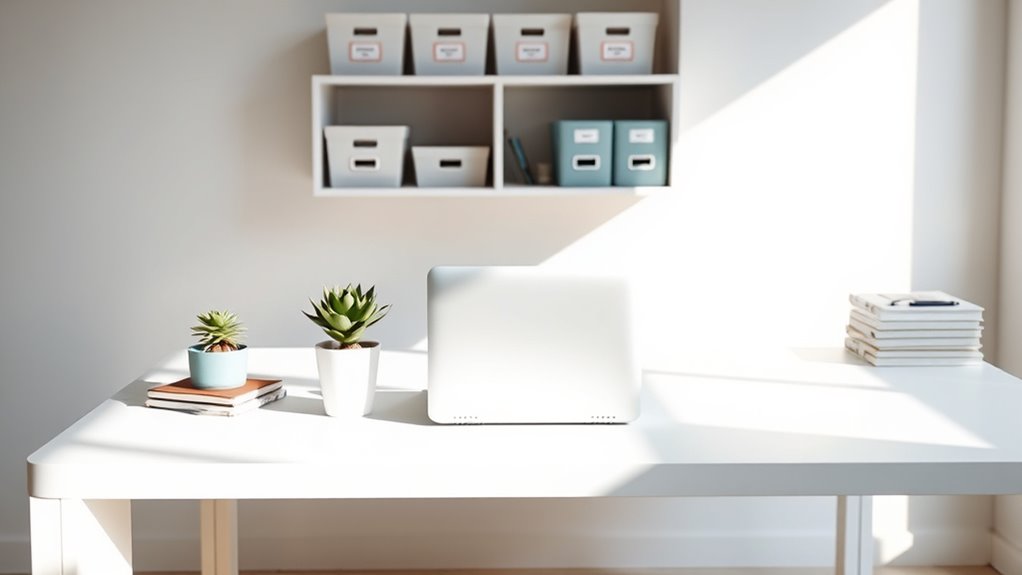
One of the most common mistakes that leads to disorganization is neglecting regular cleanup routines. When you ignore this habit, paper clutter quickly accumulates, making it harder to find important documents and increasing stress. Misplaced items, like pens or notepads, become frequent annoyances because you don’t take time to put things back in their proper place. Over time, this chaos hampers your productivity and hampers creative thinking. Instead of organizing your workspace daily, you allow clutter to build up, which creates mental barriers and distractions. To avoid this mistake, set aside a few minutes each day to clear paper clutter and return misplaced items to their designated spots. Consistent upkeep keeps your desk tidy, fostering a clearer mind and sharper focus.
Long-Term Benefits of Maintaining a Clean Workspace

Maintaining a clean workspace offers ongoing advantages that extend beyond immediate organization. When you prioritize regular upkeep, you improve workspace ergonomics, reducing physical strain and increasing comfort. It also encourages digital decluttering, which minimizes distractions and streamlines your workflow. Over time, these habits boost your productivity and mental clarity. Here are three long-term benefits:
- Enhanced focus and creativity by limiting visual clutter.
- Reduced stress levels, creating a calmer work environment.
- Greater efficiency through easier access to tools and documents.
Consistently keeping your workspace tidy helps prevent chaos from building up, making it easier to maintain good habits and stay motivated. The benefits compound, offering a more sustainable, enjoyable work experience that nurtures both your well-being and your creative potential.
Frequently Asked Questions
How Does Clutter Influence Decision-Making Processes?
Clutter considerably impacts your decision-making by creating visual clutter, which distracts you from important choices. When your space is messy, cognitive overload occurs, making it harder to focus and process information efficiently. This mental chaos can lead to rushed or poor decisions. To improve your decision-making, keep your workspace organized, reduce visual clutter, and give your brain a clearer environment to analyze options and make better choices.
Can a Clean Desk Improve Mental Health?
A clean desk can definitely improve your mental health by creating a calming environment. When you keep your space organized, you’re more likely to practice mindfulness and reduce stress. A clutter-free workspace minimizes distractions, helping you focus and feel more in control. Incorporate mindfulness practices into your routine to enhance this effect. As a result, you’ll experience better mental clarity, lower anxiety, and a greater sense of well-being throughout your day.
What Role Does Color Play in a Clutter-Free Environment?
Color plays a crucial role in creating a clutter-free environment, acting like a calming breeze for your mind. Using the principles of color psychology and visual harmony, you can choose hues that promote focus and tranquility. Bright or bold colors might energize you, while softer tones foster relaxation. When your space’s colors complement each other, they enhance clarity and reduce stress, turning your desk into a sanctuary of productivity.
How Quickly Can Organizational Habits Lead to Increased Creativity?
Organizational habits can boost your creativity within just a few weeks. By practicing consistent habit formation and prioritizing time management, you create a clutter-free environment that sparks innovation. When you develop routines to stay organized, your mind can focus more on ideas rather than distractions. This quick shift helps you release creative potential faster, making your workspace a powerful tool for inspiration and productivity.
Are There Specific Personality Traits Linked to Clutter Accumulation?
You might find that your personality traits, like being spontaneous or easily distracted, often correlate with clutter accumulation. If you’re more laid-back or creative, clutter can feel like a messy masterpiece rather than chaos. Conversely, highly organized individuals tend to have a trait correlation toward tidiness. Your personality shapes how you manage clutter, influencing whether it’s a creative chaos or an obstacle, making awareness of these traits key to cultivating a productive space.
Conclusion
A clutter-free desk cultivates clarity, creativity, and confidence. By banishing chaos and embracing organization, you boost your brainpower and break barriers to brilliance. Stay steadfast in your pursuit of simplicity, steering clear of common clutter-causing mistakes. Remember, a tidy workspace isn’t just about tidiness—it’s about transforming your thoughts and releasing your full potential. Clear the chaos, cultivate your creativity, and watch your work soar to new heights. Your spotless space sparks spectacular success!