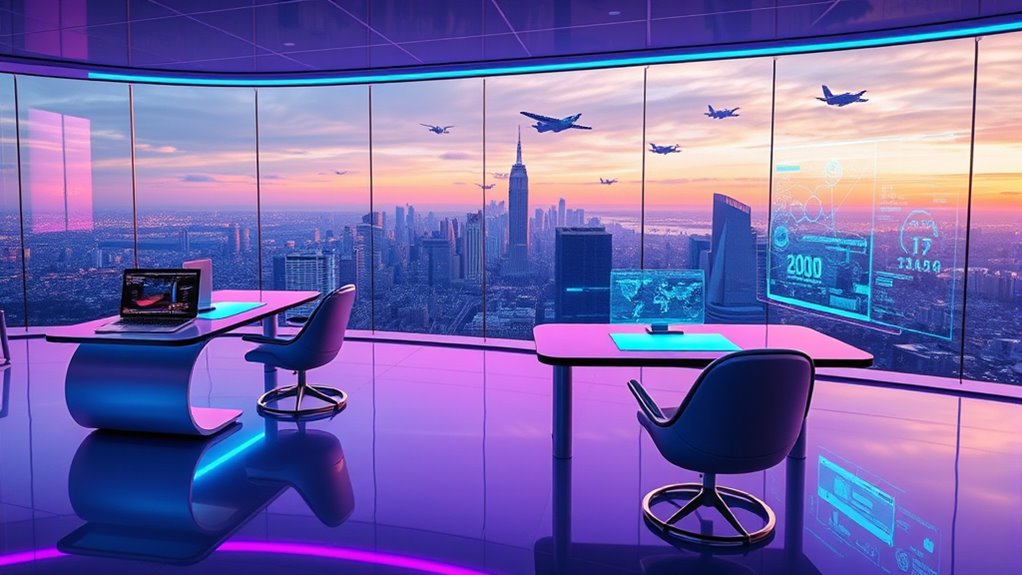

Futuristic movies often show offices with seamless AI, immersive virtual environments, and advanced tech that transform work. They get some things right, like AI managing tasks and virtual reality allowing remote collaboration. However, they tend to exaggerate, ignoring practical challenges like high costs, hardware limits, and privacy issues. If you keep exploring, you’ll discover how these visions compare to real technological progress and the obstacles ahead.
Key Takeaways
- Movies often depict seamless AI integration managing tasks, but real implementations face challenges like costs and technical complexity.
- Virtual reality in films shows immersive, holographic collaboration, yet hardware limitations and user comfort issues are underrepresented.
- Futuristic offices emphasize enhanced productivity and connectivity, reflecting real trends supported by cloud computing and AI.
- Films tend to exaggerate ease of adopting advanced tech, overlooking practical hurdles such as privacy concerns and learning curves.
- The portrayal of smarter, more interactive workplaces inspires innovation, though actual deployment remains complex and resource-intensive.
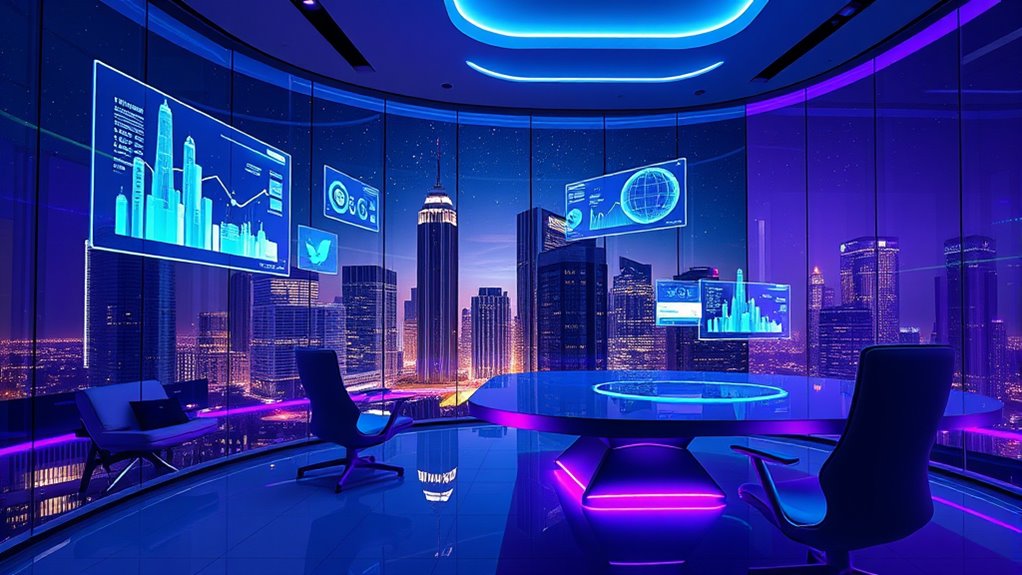
Futuristic office movies transport you to workplaces powered by advanced technology, where artificial intelligence, robotics, and innovative designs shape the daily grind. These films often depict a seamless integration of AI, transforming how tasks are managed and decisions are made. You might see AI systems that handle scheduling, data analysis, and even creative processes, freeing you from mundane chores and allowing you to focus on strategic thinking. In these visions, AI integration isn’t just a tool—it’s a central hub that collaborates with humans, offering insights and automating complex workflows. It’s easy to imagine walking into a workspace where your AI assistant anticipates your needs, suggests *ideal* meeting times, or even drafts reports while you attend to more pressing matters.
Virtual reality environments are another striking feature in these movies, creating immersive worlds where you can interact with digital spaces as if they’re real. You might find yourself donning a VR headset to enter a virtual conference room, where colleagues from across the globe appear as holographic projections. These environments aim to simulate physical presence, making remote collaboration feel almost tangible. You could walk around a virtual office, manipulate digital objects, or brainstorm with your team in a 3D space that adapts to your needs. While these depictions are visually *engaging*, they often overlook some practical hurdles. For example, the *seamlessness* of VR in movies may gloss over the technical challenges of latency, user comfort, and hardware limitations. Additionally, the rapid evolution of cloud computing technology is essential for supporting such immersive environments efficiently. Still, they paint an exciting picture of a future where virtual environments are integral to daily work, making remote interactions more natural and engaging.
However, these movies sometimes overstate how quickly and effortlessly these technologies will become mainstream. They portray a world where AI and VR are fully integrated into every aspect of work, often ignoring the current hurdles like cost, privacy concerns, and the learning curve associated with new tools. You might expect instant adoption, but real-world implementation tends to be slower and more complex. Nonetheless, the core ideas—AI integration and virtual reality environments—highlight a future where technology enhances productivity and connectivity. They inspire you to imagine a workspace that’s more efficient, collaborative, and *immersive* than anything we experience today. Although some aspects are exaggerated, these movies give a glimpse of what’s possible if technology continues to evolve at a rapid pace, shaping the offices of tomorrow into smarter, more interactive environments.
Frequently Asked Questions
How Accurately Do Sci-Fi Movies Predict Future Office Technology?
Sci-fi movies often predict future office technology quite accurately, especially with virtual reality and robotic assistants. You can expect immersive virtual meetings that feel real and robotic helpers that handle routine tasks, increasing efficiency. While some predictions are a bit exaggerated, many films capture the essence of how these technologies could transform your workspace, making your daily work more interactive, automated, and connected.
Do Future Office Designs Improve Employee Productivity and Well-Being?
Studies show that 70% of employees feel more productive in well-designed workspaces. Future office designs do improve productivity and well-being, especially with ergonomic innovations that reduce strain and virtual collaboration tools that foster seamless communication. These advancements create healthier, more engaging environments, enabling you to work smarter. As technology evolves, your workspace becomes more adaptable, helping you stay motivated, connected, and comfortable throughout your workday.
Are Ai-Driven Offices Depicted in Movies Feasible With Current Technology?
AI-driven offices depicted in movies are partially feasible today. You can experience virtual reality meetings and interact with robotic assistants that help organize tasks or fetch information. However, full integration of AI, virtual reality, and robotic assistants functioning seamlessly in everyday workspaces still faces technical challenges. While some elements are here now, creating a truly autonomous, fully AI-driven office environment remains a future goal, not an immediate reality.
What Are Common Misconceptions About Futuristic Workspaces in Films?
You might think futuristic workspaces are all about virtual reality and robotic assistants, but movies often exaggerate their capabilities. While VR can enhance collaboration, complete immersion isn’t yet practical for daily work. Robotic assistants are helpful but not as autonomous as films suggest. Don’t expect sci-fi office scenes to reflect real tech exactly; they often simplify or dramatize to create a more exciting vision of the future.
How Do Movies Portray Office Culture in a Futuristic Setting?
Movies often show office culture in futuristic settings as highly virtual, with seamless virtual collaboration that blurs traditional boundaries. You might see a flat or even absent corporate hierarchy, emphasizing equality and innovation. However, these portrayals sometimes overlook the persistence of power dynamics and the challenges of remote teamwork. While exciting, they can oversimplify how corporate culture truly evolves in future workspaces.
Conclusion
As you reflect on these visions of the future, one thing becomes clear: the office of tomorrow holds secrets we’ve only begun to uncover. Will technology truly elevate our work lives, or will it entangle us in unforeseen ways? The line between innovation and uncertainty blurs, leaving you to wonder—are these movies warning us or inspiring us? The future of work remains an open book, waiting to be written.