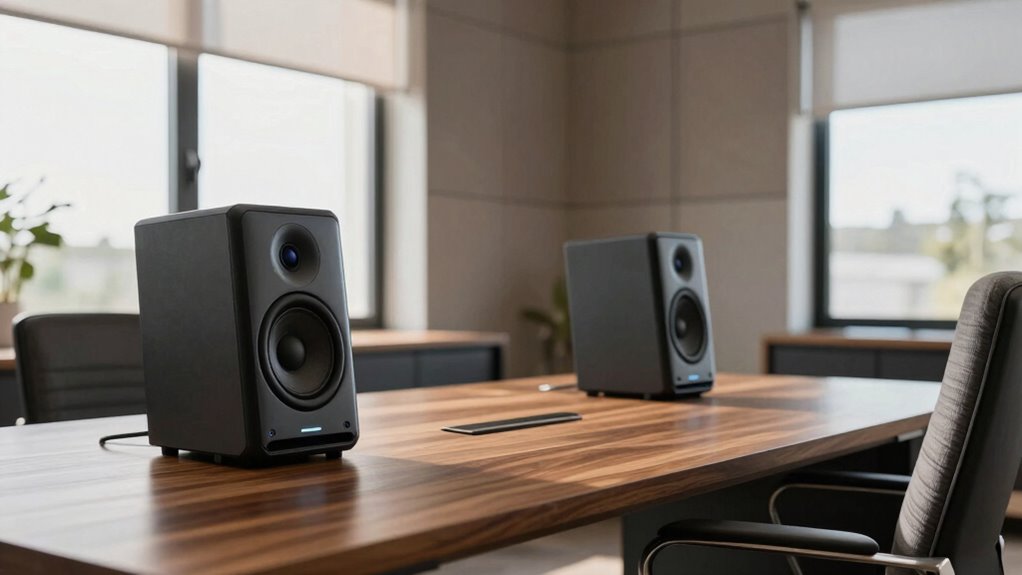

To guarantee clear, consistent audio during remote meetings in quiet rooms, invest in high-quality conference speakers with advanced microphone technologies. Proper placement and adjustable models help capture voices accurately while reducing background noise and echo. Features like noise cancellation and automatic gain control improve sound clarity, making communication smooth and effective. Using the right equipment boosts engagement and minimizes misunderstandings. For more tips on choosing the best conference speakers, keep exploring how the right tech can enhance your meetings.

Get your wardrobe favorites delivered free — and shop member deals
- Fast, free delivery on millions of items
- Access to Prime Big Deal Days deals on October 6–7
- Prime Video, Amazon Music and more included
Key Takeaways
- Choose conference speakers with noise-canceling and echo reduction features for clear audio in quiet rooms.
- Opt for models with multiple microphones or arrays to ensure even sound pickup from all participants.
- Prioritize devices with automatic gain control and sound calibration for consistent audio quality.
- Proper microphone placement and adjustable features enhance voice clarity and reduce ambient noise.
- Investing in high-quality, purpose-built conference speakers improves engagement and communication effectiveness.

In quiet rooms, clear audio is vital for effective remote meetings, and the right conference speaker can make all the difference. When you’re focused on a virtual discussion, poor sound quality can cause misunderstandings, frustration, and missed details. That’s why choosing a conference speaker with excellent sound quality is essential. You want a device that captures your voice clearly and reproduces others’ voices without distortion or background noise. High-quality sound ensures everyone hears what’s being said, maintaining the flow of the meeting and reducing the need for repeats or clarifications.
Clear audio in quiet rooms is essential for effective remote meetings and smooth communication.
Microphone placement plays a significant role in achieving ideal sound quality. If the microphone isn’t positioned correctly, your voice may sound distant, muffled, or inconsistent. When shopping for a conference speaker, look for models with adjustable microphones or those that automatically focus on the speaker’s voice. Proper microphone placement helps isolate your voice from any ambient noise, even in quiet rooms, and guarantees your speech is captured accurately. Keep in mind that some speakers have multiple microphones or arrays that work together to pick up sound evenly from different angles, which can be beneficial if multiple people are speaking or moving around. Additionally, understanding the importance of microphone array technology can help you choose a device that captures sound more evenly and accurately from multiple directions. Furthermore, advancements in sound processing technology significantly improve the overall clarity and quality of audio in remote meetings. When selecting a device, pay attention to audio calibration features, which can automatically optimize sound settings for the environment and individual users, ensuring consistent audio quality. Incorporating automatic gain control can also help maintain consistent volume levels, regardless of variations in speaking volume. Implementing proper microphone placement techniques can further enhance audio clarity and reduce handling noise or positioning issues.
Additionally, pay attention to features that enhance sound quality, like noise-canceling technology or echo reduction. These features help maintain clarity in a quiet room by eliminating subtle sounds that can interfere with communication. When you position your microphone correctly and choose a speaker with strong sound quality, you’ll notice a significant improvement in your remote meetings. Clear audio fosters better engagement, helps convey your message effectively, and keeps everyone on the same page. Ultimately, investing in the right conference speaker with proper microphone placement guarantees your remote meetings are productive, professional, and free of distracting audio issues.
conference speaker with noise cancellation
As an affiliate, we earn on qualifying purchases.
As an affiliate, we earn on qualifying purchases.
Frequently Asked Questions
How Do I Choose the Best Speaker for My Room Size?
You should choose a speaker based on your room size, considering room acoustics and speaker placement. For small rooms, opt for compact speakers with good voice clarity, while larger spaces need more powerful models with wider sound dispersion. Place the speaker centrally and at ear level to maximize sound quality. Adjust placement to avoid echoes and dead spots, ensuring everyone hears clearly during remote meetings.
Are Wireless Speakers More Reliable Than Wired Options?
Wireless speakers might seem more convenient, but are they truly more reliable? The answer depends on your needs. Wireless connectivity can sometimes suffer from interference, causing audio latency and dropouts. If you prioritize stability, wired options often outperform wireless, providing consistent sound without lag. However, if flexibility and ease of setup are your goals, a high-quality wireless speaker could work well—just be prepared for occasional hiccups in connection.
Which Speakers Offer the Best Noise Cancellation Features?
You’ll want speakers with exceptional noise cancellation features to block background noise effectively. Look for models with advanced active noise cancellation (ANC) that adapt to your environment. Good microphone quality guarantees your voice comes through clearly, even with ambient sounds. Brands like Bose, Sony, and Jabra offer excellent noise-canceling speakers designed for remote meetings, helping you stay focused and heard clearly in quiet rooms or noisy environments.
How Do I Connect Speakers to Various Remote Meeting Platforms?
You can easily connect your speakers to various remote meeting platforms by using the appropriate cables or Bluetooth pairing. Don’t worry about compatibility—most modern speakers seamlessly integrate with platforms like Zoom, Teams, or Skype. Focus on audio quality and microphone clarity, ensuring your setup is optimized. Just select the speaker as your audio device in the platform’s settings, and you’ll enjoy clear communication, even in quiet rooms.
What Is the Average Lifespan of a Good Conference Speaker?
A good conference speaker typically lasts around 3 to 5 years, depending on usage and maintenance. You’ll notice the audio quality may decline over time, and the battery life might shorten, affecting your meetings. To extend its lifespan, keep it clean, avoid extreme temperatures, and regularly charge the battery. With proper care, your speaker can serve you well during numerous remote meetings, maintaining clear sound and reliable battery life.
adjustable microphone conference speaker
As an affiliate, we earn on qualifying purchases.
As an affiliate, we earn on qualifying purchases.
Conclusion
Remember, creating a calm, clutter-free corner can cultivate clarity and confidence during remote meetings. By choosing quiet, comfortable spaces, you not only enhance your audio and focus but also foster a more professional presence. When your workspace is well-worn and welcoming, your words will resonate more powerfully. So, set your scene, silence the distractions, and speak with sincerity—because a peaceful perch promotes productivity and poise in every conversation.
multi-microphone conference speaker
As an affiliate, we earn on qualifying purchases.
As an affiliate, we earn on qualifying purchases.
automatic gain control speaker for meetings
As an affiliate, we earn on qualifying purchases.
As an affiliate, we earn on qualifying purchases.
Fall Picks
fall essentials
As an affiliate, we earn on qualifying purchases.